
DNS Check enables you to troubleshoot DNS issues by verifying that your DNS servers return the correct DNS records.
For example, if you have multiple DNS servers and suspect that there are replication issues, you could:
- Create a new DNS record group
- Import your zone file(s)
- Test the imported records on each DNS server
If there are replication errors, the test above identifies the affected DNS records and name servers.
You can also identify and troubleshoot intermittent DNS issues by viewing a DNS record's history and looking for patterns.
Suggested Fix Report
When a DNS record fails, the Suggested Fix Report shows exactly what action you need to take. DNS Check performs a character-by-character comparison of the expected and found records for you, and provides clear guidance on what to fix.
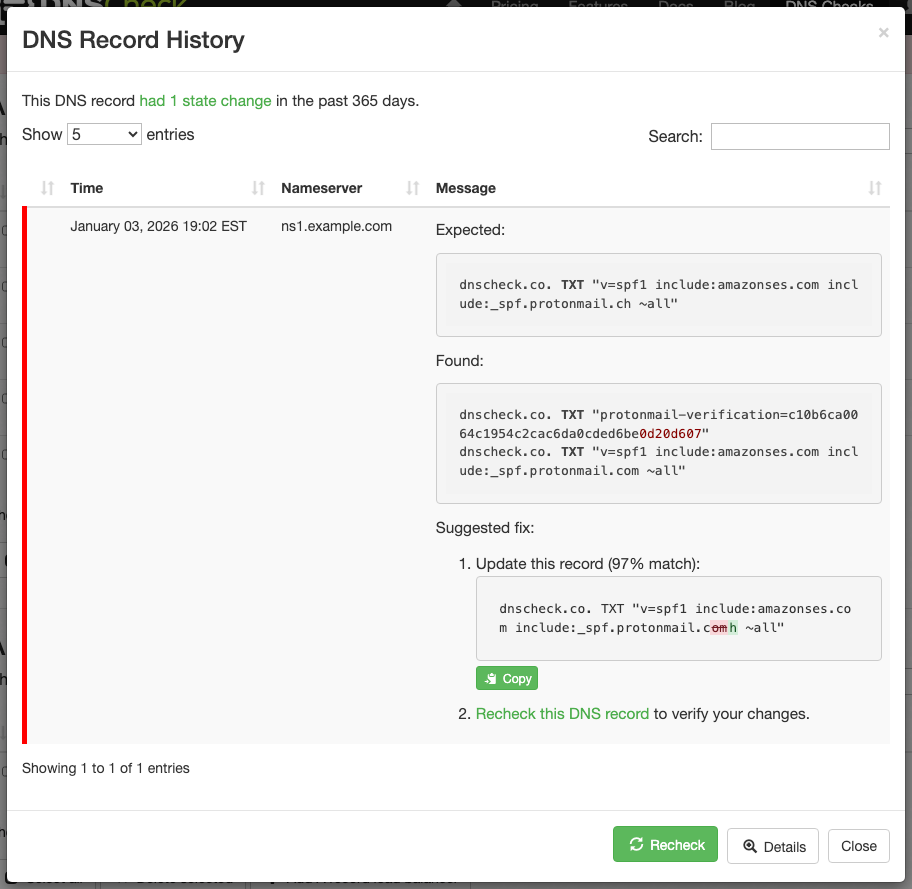
You can access the Suggested Fix Report in two ways:
- Recheck a failing record: Click a DNS record's drop-down menu and select Recheck. If the record fails, the error report tells you why, including a Suggested Fix Report when the error is with the DNS records returned by your name server, rather than an upstream error such as a communication failure.
- View a failing history entry: Open a DNS record's history (described below) and view any failing entry to see the Suggested Fix Report for that point in time.
The report provides several types of guidance. Most actions are changes to make in DNS, while the duplicate-record action is a change to make in DNS Check itself, so each label states where the change belongs:
- Create this DNS record: When an expected DNS record is missing, the report displays the full record you need to create, highlighted in green.
- Update this DNS record: When a DNS record exists but contains a typo, the report highlights the exact characters that are incorrect. Incorrect characters appear in red strikethrough, while correct replacement characters are highlighted green. A match percentage helps confirm when a difference is likely a typo rather than a completely wrong value.
- Delete this DNS record: For exclusive DNS checks where extra unwanted records exist, the report shows which records to delete, highlighted in red.
- Delete this duplicate record in DNS Check: When the same record is entered into DNS Check more times than it appears in DNS, the surplus copies can never match. The report suggests removing the extra copies from DNS Check.
This is particularly valuable for long TXT records, like SPF or DKIM, where a single typo can be buried in a string of dozens of characters.
DNS Record History
DNS Check records all state changes for your DNS records, regardless of whether a notification was sent. This complete history makes troubleshooting easier because you can see exactly what happened to DNS records over time and identify failure patterns.
To view the history for a DNS record, click its drop-down menu, then select History. That loads a report showing the history of state changes (e.g., transitioning between passing and failing states) for that DNS record.
The history includes:
- Initial check results when a new DNS record is first added
- Failures caused by the wrong value being returned
- ServFail errors and other transient issues
- Transitions from a passing state to a failing state
- The name server that sent the response. This is useful for troubleshooting periodic failures caused by issues like out-of-date NS records or an authoritative name server becoming out of sync.
DNS Record History Retention
DNS Check accounts retain 7 to 365 days of DNS record history, depending on account type:
| Plan | History Retention |
|---|---|
| Basic | 7 days |
| Professional | 90 days |
| Enterprise | 365 days |

Protect your DNS infrastructure with automated monitoring
Get notified immediately when DNS records change. Start monitoring your critical DNS infrastructure for free in under 5 minutes.
No credit card required • Cancel anytime