
This page describes the notification options available in DNS Check. Notifications are sent each time a DNS record changes state between untested, passing, and failing, unless one of the following conditions is met:
- The DNS record was just created, and its first test result was a pass
- Notifications are disabled for the DNS record's group
- The transition is to Failing, but the failure is a suppressed ServFail error
Alerts sent to paging services are the exception: they repeat while a DNS record keeps failing. See Repeating Alerts below.
Emailed Notifications
To enable emailed notifications:
- Go to the Email tab on your Notification Settings page.
- Select your desired email notification frequency, then click Save.
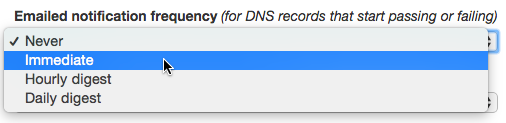
If the Immediate option is selected, DNS Check will email you a notification immediately when a DNS record changes state between passing and failing.
If the Hourly digest or Daily digest option is selected, emails are batched so you'll receive no more than one email about DNS record changes per hour or day, respectively. For example, if 10 DNS records change state between these digests, DNS Check will list all 10 state changes in a single email.
Notifications are emailed to the email address in your account's profile.
Additional Email Recipients (Enterprise Accounts)
Enterprise accounts can send notification emails to additional email recipients beyond the primary account email address. This is useful for people who need to receive notifications but don't need to log in to DNS Check. If someone needs to log in and work with your DNS records, consider adding them as a team member instead.
Additional Email Recipient Limits
The number of additional email recipients you can add depends on your plan:
| Plan | Additional Email Recipients |
|---|---|
| Basic | Not available |
| Professional | Not available |
| Enterprise | Up to 5 |
| Enterprise x2 | Up to 10 |
| Enterprise x3 | Up to 15 |
See our Pricing page for plan details.
If you need more than 15 additional email recipients, contact us for a custom plan.
To add additional email recipients:
- Go to the Email tab on your Notification Settings page.
- In the Additional Email Recipients section, click the Add email recipient button.
- Enter the email address and click Save.
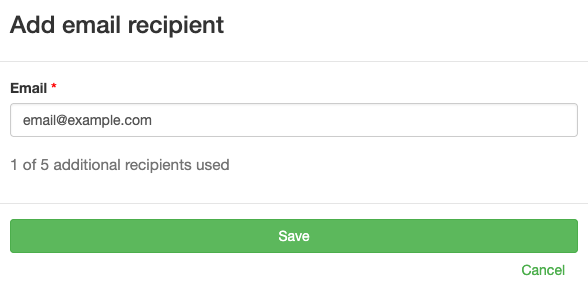
The recipient will receive a confirmation email and must click the confirmation link to start receiving notifications.
You can manage recipients from the Notification Settings page:
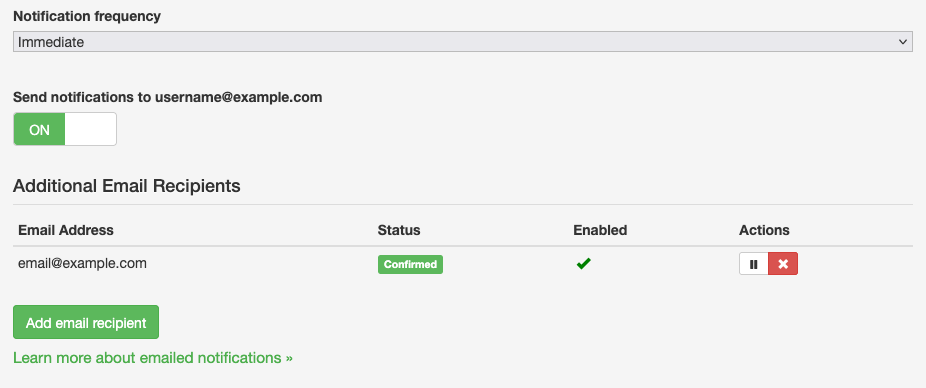
Each recipient's drop-down menu lets you:
- Resend confirmation email - If the initial confirmation email was not received
- Enable/Disable - Temporarily pause notifications without removing the recipient
- Delete - Permanently remove the recipient from your account
Recipients can unsubscribe from notifications at any time using the unsubscribe link in any notification email. If a recipient unsubscribes, you will need to select Resend confirmation to resubscribe from its menu to send them a resubscribe confirmation email.
You can also control whether your primary account email address receives notifications by toggling the "Send notifications to [your email]" checkbox on the Email tab of your Notification Settings. This is useful if you only want additional recipients to receive notifications.
Getting Paged
You can integrate DNS Check with the following services to get paged when an issue is detected:
Repeating Alerts
Email, chat, and webhook notifications are sent once, when the DNS record changes state. The paging services above are different: while a DNS record keeps failing, DNS Check re-sends its alert every 30 minutes. An alert can only be re-sent when the record is checked, so in a record group whose Check frequency is Every hour, the alert is re-sent every hour.
The repeats aren't extra pages. Each one reuses the identifier DNS Check assigned to the original alert (PagerDuty's incident key, the Jira Service Management and OpsGenie alias, and Splunk On-Call's entity ID all derive from the DNS record), so your paging service folds the repeat into the already open incident rather than creating a second one. While the incident stays open, a repeat won't page you again.
Repeats keep your paging service's view of the record in sync with ours. If someone resolves the incident while the DNS record is still failing, the next repeat raises a new one.
Repeats are timed from the alert that was actually sent, not from the first failing check, so a failure whose notification was held back by your ServFail Notification Threshold repeats on a schedule counted from the check that reached the threshold.
Repeats stop when the DNS record passes again, which sends the recovery notification that resolves the incident. If the record is still failing 24 hours after the first alert, DNS Check stops repeating it. The incident stays open until the record passes or someone resolves it.
Chat Notifications
DNS Check can send notifications via the following chat services:
Webhooks (Enterprise Accounts)
Enterprise accounts can post a signed notification to their own HTTPS endpoints each time a DNS record starts passing or failing, and to apps such as Discord, Google Chat, and ntfy. See Webhooks for setup instructions, body formats, and signature verification.
ServFail Errors
Most of the DNS errors that DNS Check detects are ServFail errors. ServFail errors indicate an error communicating with the DNS server, not an issue with the data it returned. You can configure how quickly DNS Check notifies you about ServFail errors by editing the "ServFail Notification Threshold" setting in your Notification Settings page:

Our DNS SERVFAIL Errors page discusses ServFail errors in more detail, including what causes them and how to choose a threshold.
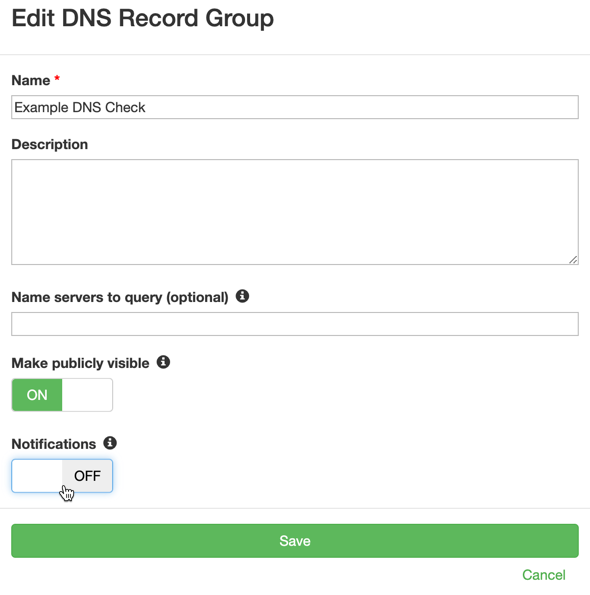
Disable Notifications for a DNS Record Group
You can turn off all notifications for a DNS record group by toggling the "Send notifications" option off:
The DNS Check API
The DNS Check API can extend the DNS record monitoring capabilities of other applications, including:

Protect your DNS infrastructure with automated monitoring
Get notified immediately when DNS records change. Start monitoring your critical DNS infrastructure for free in under 5 minutes.
No credit card required • Cancel anytime